

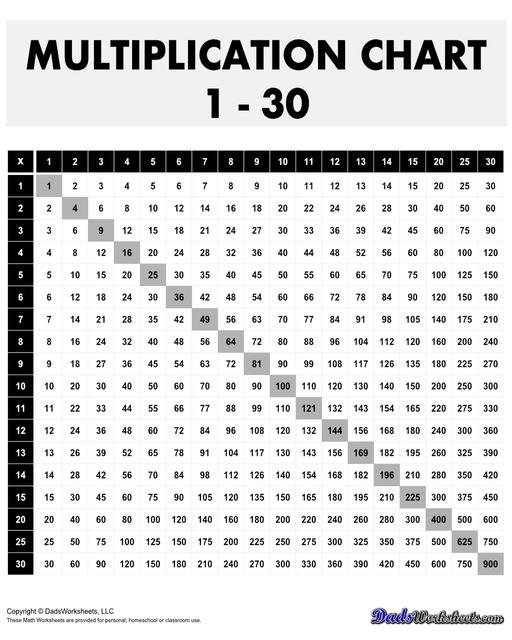
Ultimate Multiplication Chart 1-30: Master Math Facts Efficiently
The multiplication chart 1-30 is a valuable tool for mastering multiplication facts efficiently. This comprehensive chart showcases the products of multiplying numbers from 1 to 30, offering a quick reference for students and educators alike. Whether you are learning basic multiplication or aiming to improve your recall speed, the multiplication chart 1-30 is a must-have resource. Dive into this guide to unlock the potential of this handy chart and enhance your mathematical skills effortlessly. Start exploring the endless possibilities that the multiplication chart 1-30 has to offer today.

Multiplication Chart 1-30: Unlocking the Magic of Numbers
Welcome to the world of multiplication, where numbers come alive and create endless possibilities! In this article, we will delve into the fascinating realm of the multiplication chart 1-30. Whether you’re a math enthusiast or just starting your journey with numbers, this guide will help you unlock the magic of multiplication in a fun and engaging way.
The Basics of Multiplication
Before we dive into the specifics of the multiplication chart 1-30, let’s brush up on the basics of multiplication. Multiplication is a mathematical operation that combines equal groups to find a total. When we multiply two numbers, we are essentially adding one number to itself multiple times. For example, 3 x 4 means we are adding 3 four times, which equals 12. It’s like creating a mini universe of numbers!
Understanding the Multiplication Chart
Now, let’s talk about the multiplication chart. Imagine a grid filled with numbers from 1 to 30 both horizontally and vertically. Each intersection of two numbers on the grid represents the result of multiplying the corresponding numbers. For instance, if you look at the square where row 4 meets column 7, you will find the product of 4 x 7, which is 28.
Using a multiplication chart makes it easier to quickly find the products of different numbers without having to perform the calculations from scratch. It’s like having a cheat sheet that helps you navigate the world of multiplication with ease!
Exploring Patterns in the Multiplication Chart
One of the most fascinating aspects of the multiplication chart 1-30 is the patterns that emerge as you explore the grid. Patterns can help you predict the products of certain numbers and make multiplication even more exciting. Let’s look at some interesting patterns you can observe in the multiplication chart:
1. Multiples of 10
Notice how the products of numbers multiplied by 10 always end in 0. This is because when you multiply any number by 10, you are essentially adding a zero at the end of that number. For example, 3 x 10 = 30, 9 x 10 = 90, and so on. It’s a quick trick to remember when dealing with multiples of 10!
2. Squares of Numbers
If you look along the diagonal of the multiplication chart, you will find a special pattern – the squares of numbers. The square of a number is the result of multiplying that number by itself. For example, 5 x 5 = 25, 6 x 6 = 36, and so on. This diagonal of squares is a treasure trove of numerical wisdom!
3. Commutative Property
The multiplication chart also demonstrates the commutative property of multiplication, which states that the order of numbers being multiplied does not affect the result. For instance, 3 x 4 gives the same result as 4 x 3, and you can see this symmetry reflected in the multiplication chart.
Using the Multiplication Chart to Solve Problems
Now that you’ve uncovered some fascinating patterns in the multiplication chart 1-30, let’s put your newfound knowledge to the test! You can use the multiplication chart to solve a variety of math problems quickly and efficiently. Here are some examples of how you can use the multiplication chart in action:
1. Multiplying Large Numbers
When faced with multiplying larger numbers like 27 x 13, you can use the multiplication chart to find the product in seconds. Locate the row for 27 and the column for 13, and where they intersect, you’ll find the answer – 351. It’s like having a superpower for solving math problems!
2. Finding Missing Factors
Sometimes you may be given the product of two numbers and asked to find one of the factors. For example, if you know that 6 x ? = 42, you can use the multiplication chart to quickly identify that the missing factor is 7. The chart helps you fill in the missing pieces of the math puzzle!
Games and Activities with the Multiplication Chart
Math doesn’t have to be all work and no play! You can have fun with the multiplication chart 1-30 by engaging in various games and activities that make learning multiplication enjoyable. Here are some creative ideas to explore:
1. Multiplication Bingo
Create a bingo card with different multiplication problems and their solutions from the chart. Call out the multiplication factors, and players can mark the corresponding products on their bingo cards. The first to get a line or full house shouts “Bingo!” and wins. It’s a fun way to reinforce multiplication skills!
2. Multiplication Chart Races
Set up a race where each player has to find the product of a specific multiplication problem on the chart. The player who correctly identifies the product first wins the race. You can make it more challenging by timing the players and introducing higher-level multiplication problems. It’s a thrilling way to sharpen your multiplication speed!
Benefits of Mastering the Multiplication Chart
As you delve deeper into the world of the multiplication chart 1-30, you’ll discover the myriad benefits of mastering this essential math tool. Here are some of the advantages of becoming a multiplication chart maestro:
1. Quicker Mental Math Skills
By regularly using the multiplication chart, you’ll improve your mental math skills and be able to calculate products more efficiently in your head. This can be incredibly useful in everyday situations where quick math skills are needed.
2. Strong Foundation for Advanced Math
Mastering the multiplication chart lays a solid foundation for delving into more complex math concepts in the future. It forms the building blocks for understanding algebra, geometry, and other advanced mathematical topics.
3. Boosted Confidence in Math
As you gain proficiency in using the multiplication chart to solve problems, your confidence in math will soar. You’ll feel more empowered to tackle challenging math problems and approach new mathematical concepts with enthusiasm.
Congratulations on embarking on your multiplication chart adventure! You’ve explored the magical world of numbers, uncovered intriguing patterns, and honed your math skills along the way. Remember, the multiplication chart 1-30 is not just a grid of numbers – it’s a gateway to mathematical wonders waiting to be discovered. So, keep exploring, keep practicing, and unleash the magic of multiplication in everything you do!
Now, go ahead and dazzle the world with your newfound multiplication prowess. Happy multiplying!
Learn Multiplication Songs for Children |Times Tables Multiply Numbers 1-12 for Kids by Patty Shukla
Frequently Asked Questions
1. How can I use a multiplication chart 1-30 to practice my multiplication tables?
You can use a multiplication chart 1-30 to quickly find the product of any two numbers between 1 and 30. By referencing the chart, you can see the result of multiplying any two numbers without having to calculate it manually. This can help you memorize multiplication facts and improve your overall math fluency.
2. Why is a multiplication chart 1-30 useful for students learning multiplication?
A multiplication chart 1-30 provides a visual representation of the multiplication table, making it easier for students to understand and memorize multiplication facts. It helps students identify patterns in multiplication, which can improve their number sense and mental math skills. Using the chart can also build confidence in students as they practice and reinforce their multiplication knowledge.
3. How can a multiplication chart 1-30 be used in the classroom by teachers?
Teachers can use a multiplication chart 1-30 as a teaching tool to introduce multiplication concepts to students. They can demonstrate how to read and interpret the chart, and then assign exercises where students use the chart to solve multiplication problems. Teachers can also incorporate the chart into games and activities to make learning multiplication more engaging and interactive for students.
Final Thoughts
In conclusion, the multiplication chart 1-30 is a valuable tool for learning and practicing multiplication facts. It provides a visual representation of the relationships between numbers, making it easier for students to memorize and recall multiplication facts quickly. By regularly using the chart, students can improve their math skills and build a strong foundation for more advanced mathematical concepts. Embracing the multiplication chart 1-30 can lead to greater confidence and success in mathematics.

Related Posts
Essential Burritocraft Tips: A Flavorful Guide

Exploring Elly Clutch Leaked: Insights & Updates
